Ford Focus ST Map Notes
- Will Trang
- Zach Cronk
- Former user (Deleted)

Supported Vehicles:
- ADM 2013-2018 Focus ST
- CHDM 2015-2018 Focus ST
- EDM 2013-2018 Focus ST (includes Start Stop, and no Start Stop)
- USDM 2013-2018 Focus ST
| Focus ST (2013-2018) |
|---|
Map Revision:
|
Required Accessport Firmware:
- V3: 1.7.3.0-14378 or greater
Map Availability: Download from the COBB Tuning Focus ST OTS Map Database
| Map | Peak Gains | Maximum Gains |
|---|---|---|
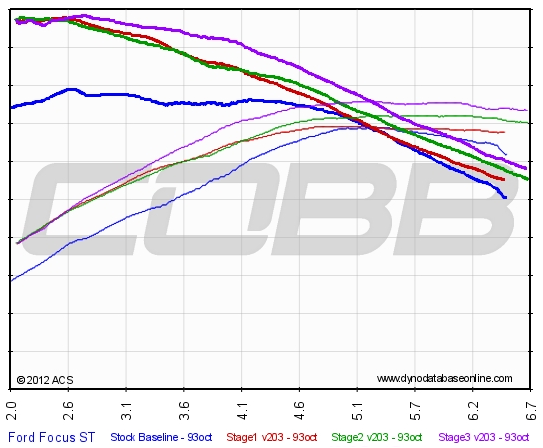
| Stage1 87* | +2% HP / +9% TQ | +8% HP / +10% TQ |
| Stage1 91* | +1% HP / +22% TQ | +4% HP / +27% TQ |
| Stage1 93 | +1% HP / +24% TQ | +5% HP / +30% TQ |
| Stage2 91 | +4% HP / +22% TQ | +10% HP / +29% TQ |
| Stage2 93 | +5% HP / +24% TQ | +11% HP / +31% TQ |
Peak Gains are measured as the absolute maximum value between the highest points of two plots.
Max. Gains are measured as the average maximum value between the highest and lowest point of two plots.
Results may vary. Power as tested on 2013-2014 Focus ST vehicles using these identical calibrations on 93oct / 98RON.
*91 and 93 octane results are compared against a 93 octane fuel baseline. Your 91 octane results may be higher than listed above; as a baseline of 91 octane fuel may read lower than our 93 octane baseline. 87 octane results compared against an 87 octane fuel baseline. Your 87 octane results may be higher than listed above if a blend of higher octane fuel is present.
Calibration Strategy Information
See our Octane Adjust Ratio technical article for additional information regarding some of the strategies we utilize in these calibrations!
Closing Warnings and Precautions:
- Use of inappropriate calibration/modification combinations will promote engine damage.
- Seek the help of a professional COBB Accesstuner Professional should your vehicle fall outside of OTS configurations.
- COBB OTS mapping is NOT designed to be used with upgraded aftermarket boost actuators or solenoids. Doing so may result in much higher than desired boost and potential engine damage. Seek the help of a COBB Accesstuner Professional should your vehicle fall outside of OTS configurations.
- Top Tier gasoline should be used where available. Use of lower quality fuels can result in catastrophic engine damage.
- WARNING: Launch Control, Flat-Foot-Shift (LC/FFS), and Burnout Mode are abusive to the engine, clutch, transmission, axles, and differential. The user accepts all risks and responsibilities when using these features.
- WARNING: Performance calibrations not designed for use when towing.
Revision History:
| Revision # | Notes: |
|---|---|
| v506 | Maps have been updated to eliminate unnecessary DTC suppression or uprevved for version parity with other maps. |
| v505 | Maps have been updated to eliminate unnecessary DTC suppression. |
| v504 |
|
| v503 |
|
| v501 | Revision number upreved for map naming parity. |
| v500 |
|
| v402 |
|
| v401 |
|
| v400 |
|
| v320 |
|
| v312 |
|
| v301 | Adjusted high load closed loop fueling for part throttle conditions. |
| v300 |
|
| v204 |
|
| v203 | Adjusted closed loop fueling targets to ensure all I/M readiness monitor tests were capable of running. Set Launch Control RPM to match Primary Rev Limit to allow full sweep testing on 2WD dynamometers. |
| v202 |
|
| v201 | Revised launch control strategy to use Rear Average VSS for more consistent launches. Eliminated "beeping" phenomenon from the Active Sound Symposer. Adjusted Dashpot and Tip-In torque limits to aid in idle stability and drivability. Set Standard FFS default to 5000 rpm |
| v200 | Added 5-Way map switching* and Flat-Foot-Shift features. Adjusted closed loop fuel settings to improve drivability on lower quality fuels. Fixed a bug that caused the Catalyst Temperature to read inaccurately high. Adjusted throttle plate delta pressure tables to aid in the removal BPV recycles. Adjusted wastegate solenoid gain profiles to aid in spool stability. Adjusted knock sensor decrement authority. Adjusted charge air temp timing reduction authority at higher temperatures. Removed OEM "Rev Hang" behavior to improve shifting behavior. |
| v101, v102, v103 | Original Release Calibration - Adjusted fuel, ignition timing, boost control (including overboost), camshaft phasing (Ti-VCT), throttle translations, EcoMode shift indicators, sound symposer, cooling fans, grill shutters, load modeling, and base programming logic. Reduced compensations for more consistent power delivery. Adjusted torque, gear, load, boost, airflow, temperature, speed, and rev limits. Enhanced OEM bypass valve performance and compatibility with aftermarket valves. |
*5-Way map switching and Ford Traction Control settings can only be configured with Accesstuner software.
Custom Feature Cruise Control Button Assignments
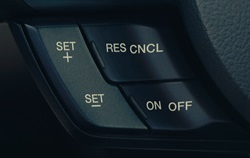
- For Custom Feature control see Custom Feature Cruise Control Button Assignments
Copyright 2025 © COBB Tuning Products LLC. All Rights Reserved. | www.cobbtuning.com